© 2014-2021 Copyright by P. K. H. Groth, Denver, Colorado, USA All rights reserved - See contact page for for permission to republish article
excerpts.
Learning from Hunting
Stories Page A
Elk Hunt 2013
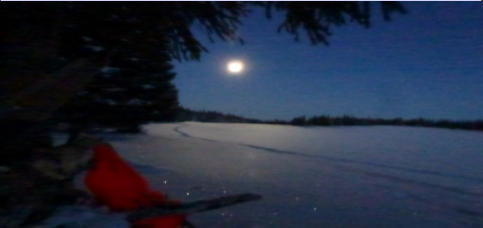
The hunt could not have been any better, although I say that each year. A giant rising full moon crept like
a huge lantern through the forest, edged slowly up through the spruce trees and danced on skag tops.
Like a glowing omen it released itself into the deep blue night sky. I lay in my sleeping bag looking in awe
out the open tent door. I could not light the lantern and interrupt my emotions. I kept trying to preserve
the scene in a photograph, but the falling temperature continued to frost my lens. Thoughts of past
family hunts flickered in my memory until shuteye at 10:30 PM.
I reviewed opening morning hunting options as I lay in my down sleeping bag during the enchanting
night vigil. The frosting grass would reduce my footfall noise, but I would have to be careful
not to step on raised vole mounds which would be topped with crunchy crystals from the
vole breathing. The falling temperature would be more severe in the valley by morning, so
the walk and ride in hunters would be up later and slower to get going. I might have the first
two hours to myself if the outfitter camp was not full of hard-core competitors.
Opening morning greeted me at 6 AM with a moon-bright, spectacular, silent, eerie,
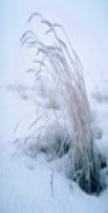
“Hunters Moonscape”. I shivered in my stand, watching the frost feathers crystalized on
grass strands in the predawn moonlight. The meadow landscape was alive with billions of
twinkling diamonds! This portended a perfect day! I had reveled in the both the evening light
of the gods and the dawn light of the angels! And the landscape was all mine to enjoy.
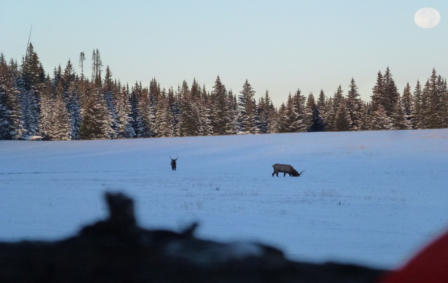
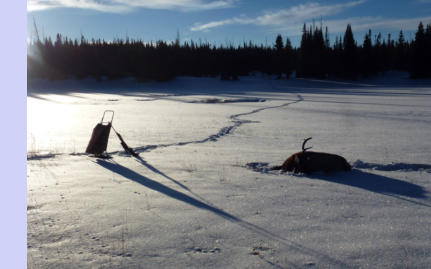
At dawn two bulls materialized in the distant treeline
and slowly grazed from 700 yards to my stand – the
smaller, more tender bull was selected to fill our
freezer. The half hour of a slowly setting full moon
and the cold blues of a frigid dawn provided a
spectacular and exhilarating wait. It just does not get
any better than this! My conclusion that day-hunters
would be late was confirmed when the heavily clothed
fellows arrived at about 9AM.
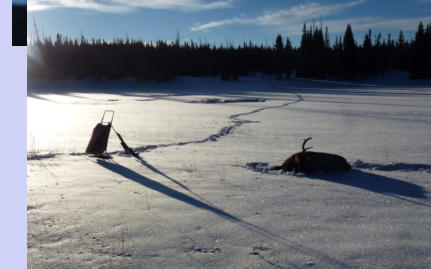
Things got even better the next day. Our family
hunting philosophy is to be silent and patient by
reading books while subconsciously remaining aware of
what the forest sounds are telling us. The next day at 1:30
PM it was warm. I sat out in the open sunlight in my
propped up backpack “lounge chair” intently reading an
old spy thriller. Then bugling began. A danged, bored
hunter stalking home for lunch in a nearby camp
practiced his poor, silly midday bugling and disturbed my
beloved wilderness peacefulness! Ten minutes later I
looked up to my right and froze. Seventy yards away
stood 18 “naked” (in the open without tree cover) elk sunning themselves, including the wacko 6X6 “big
guy” exhausted bugler! (See my book on full moon man/animal restlessness and noonday elk movement
discussions). The elk evidently never saw me until I tried to sneak to my camera and gun. The excitement
of elk hunting is that you just NEVER know WHEN the “ghosts” will UNEXPEDTEDLY appear!
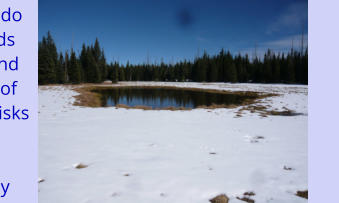
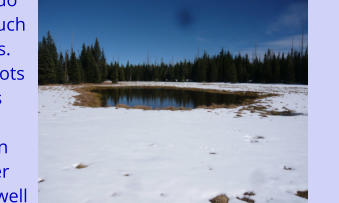
Heap Bad Water; There is often a water problem in the the Colorado
high country such as the Flat Tops. Yes, there are lots of lakes, ponds
and streams. However, up on the “flats” water does not flow well and
in late summers of dry years the shallow ponds may vanish. Much of
the available water is undrinkable, or can be consumed by taking risks
for digestion hazards because of contained organic material. The
parasite Giardia is always a threat in any water. Lastly, good water
may not be where hikers or hunters want to camp. This is especially
so during late hunt seasons when water may be frozen during the late
fall months.
Bring adequate containers to haul water. Jerry cans are good if you have horses and panniers. I suggest
plastic gallon water or milk jugs are ideal. They can be drained at the end of the back pack or hunting trip
and burned. Then the last remaining plastic “button” can be carried out of the wilderness. I recommend
duct taping together four or six empty jugs, placing the cube a pillowcase, and lashing the light-weight
cube to the back of your backpack. This arrangement keeps the individual jugs from rattling and
squirming out of the lashings. Note: don’t carry loose plastic jugs on horses, unless you want a spook
induced joy ride.
Don’t resort to drinking minor water sources. I recall a hunter complaining how utterly foul tasting the
water was he resorted to obtained from small depressions. Contemplating his description, it dawned on
me that he was drinking from elk wallows. I later pondered whether that testosterone-laden urine water
created a nightmare for his wife when he returned home. (Does she still believe she looks sexy and
ravenous doing the dishes in hair curlers?)
Abandoned Family Disaster 2019: August I encountered a volunteer Forest Service crew clearing timber
brought down by winter avalances. (They have to wait for summer heat to melt the snow before they can
untangle the timber.) I thanked them for their laborious effort, and said in return I would volunteer to
remove a large tent abandoned the previous year by hunters. That was my mistake! That K- Mart tent was
a time capsule of family misery. There were two large, thick inflatable plastic mattresses (providing no
insulation), a crib mattress, and an assortment of blankets. The water supply was a couple of cases of
pint bottles. There was a Sterno stove, hardly a tent heater. The tent was filled with nine-month ripe
vomit and soiled diapers. Children and baby rattles bespoke a mother’s misery. Was she left behind
without escape transportation when her husband wandered farther into the forest to a spike camp? Well,
at least he paid somewhat for the torture; his very small, useless-quality K-Mart hunting pocket knife was
under one mattress.
I slit the mattresses, rolled every thing up in the blue tarps rain flies and slide the heavy bundle up some
pine poles into my suburban. The garbage bags I carry were filled with the plastic bottles, charcoal grill,
bean cans and camp trash; the Suburban was filled to the roof. The window-open ride home was an odor
nightmare, as was the mentally reconstructed torture of a young mother who will never again enter the
outdoors. I helped my displeased garbage man lift the camp corpse bundle and gave him a twenty dollar
bill to ease his consternation. I learned a lot for my $20!
Smart Students: I chatted with a very happy, tickled pink outfitter. He had three University of Colorado
students as clients. They came with their own food. If you know Boulder, Colorado University students or
have been to one of their tailgate parties, you can imagine it was not peanut butter and jelly. They had
planned for gastronomic excellence, bringing spices, pre-dinner snacks of fancy cheeses, pate’ and baked
cakes. Moreover, they had called ahead so they had brought plenty of food for the outfitter crew. They
joyously prepared the meals in challenges for cooking excellence. They almost immediately got a bull
without trying very hard (they were in good shape and attitude acclimated). The best reward was that
their conviviality got them a ten year elk hunting experience education from the crew during the next two
days of conversations, interactions, and helping around base camp. You do not have to pay for all
education, but you have to earn it. I know those students will go far in life no matter what they do. And
any friends they refer to the outfitter will receive special treatment. It is called “social networking.”
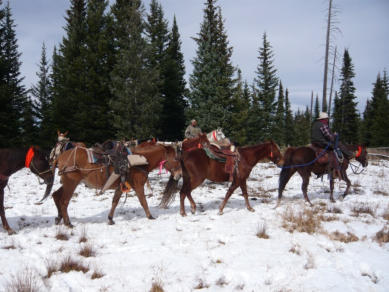
Elk Camp Safety Checks Then and Now: An awful lot has changed during my fifty years of elk hunting,
but there is still the need to have some emergency support if you hunt the roadless backcountry. I recall
an early 1970’s outfitter had an employee who would make camp check every day. He silently semi-
appeared mid-morning, courteously walking within the tree lines like a fleeting shadow. He lingered a
minute or two to observe before moving across open areas so he would not disturb game or hunters. He
never approached anybody on a stand. We learned he was Sam, who daily made trips to each one of the
outfitters scattered wilderness drop and contract camps. Then he would enjoy the down-mountain trek
to report at the outfitter’s base camp. All told, he must have daily traveled twelve to fifteen miles in his
circuit. This religiously happened in all kinds of weather.
It is mid-February as I write this memory exposed by a Tennessee hunter’s e-mail inquiry about my
website, book, and tips on remotely using a CPAP sleep apnea machine at 10,000-foot altitude. I was
somewhat apprehensive about him being a novice to late October Colorado backcountry hunting. Two
years before I encountered Tennessee hunters who came with inadequate equipment, including a mesh-
toped summer tent of poor wind-resistance design. I really felt sorry they probably never did hunt, since
they were blown out and fled in the middle of the first night. (I had seen first night panic escapes before.)
I was relieved hearing that the experienced hunters would be well prepared, evidently would be overseen
by an outfitter, and would enjoy heated wall tents (with floors, I hope). They also would benefit with
timed evening satellite phone check-ins with the outfitter, had GPS maps, and cell phones (that hopefully
will work there). What a stark comparison to Sam’s laborious safety checks of fifty years distant!
I sit with my sunset glass of Madeira and wistfully wonder. Did the Forest Service allow wilderness-
wandering Sam to be buried where he faithfully toiled? Did government regulations permit him to wear
his red safety bandanna and notes-carrying collar into doggy eternity?












- Hunter welfare
- Hunter poster child
- Altitude sickness
- Hunter heart attacks
- Hunter heart stress
- Altitude sleep problems
- Hunter spine/bone damage
- Back country hazards
- Man made hazards
- Hunter bear attacks
- Bear problems
- Mtn lion Awareness
- Insect problems and diseases
- Hunt camp rodent problems
- Game meat dangers
- Elk meat diseases







© 2016 -2021 Copyright by P. K. H. Groth, Denver, Colorado, USA All rights reserved -
See contact page for for permission to republish article excerpts.
Learning from Hunting
Stories Page A
Elk Hunt 2013
The hunt could not have been any better, although I
say that each year. A giant rising full moon crept like
a huge lantern through the forest, edged slowly up
through the spruce trees and danced on skag tops.
Like a glowing omen it released itself into the deep
blue night sky. I lay in my sleeping bag looking in
awe out the open tent door. I could not light the
lantern and interrupt my emotions. I kept trying to
preserve the scene in a photograph, but the falling
temperature continued to frost my lens. Thoughts
of past family hunts flickered in my memory until
shuteye at 10:30 PM.
I reviewed opening morning hunting options as I
lay in my down sleeping bag during
the enchanting night vigil. The frosting
grass would reduce my footfall noise,
but I would have to be careful not to
step on raised vole mounds which
would be topped with crunchy crystals
from the vole breathing. The falling
temperature would be more severe in
the valley by morning, so the walk and
ride in hunters would be up later and
slower to get going. I might have the first two hours
to myself if the outfitter camp was not full of hard-
core competitors.
Opening morning greeted me at 6 AM with a moon-
bright, spectacular, silent, eerie, “Hunters
Moonscape”. I shivered in my stand, watching the
frost feathers crystalized on grass strands in the
predawn moonlight. The meadow landscape was
alive with billions of twinkling diamonds! This
portended a perfect day! I had reveled in the both
the evening light of the gods and the dawn light of
the angels! And the landscape was all mine to enjoy.
At dawn two bulls materialized in the distant
treeline and slowly grazed from 700 yards to my
stand – the smaller, more tender bull was selected
to fill our freezer. The half hour of a slowly setting
full moon and the cold blues of a frigid dawn
provided a spectacular and exhilarating wait. It just
does not get any better than this! My conclusion
that day-hunters would be late was confirmed when
the heavily clothed fellows arrived at about 9AM.
Things got even better the next day. Our family
hunting philosophy is to be silent and patient by
reading books while subconsciously remaining
aware of what the forest sounds are telling us. The
next day at 1:30 PM it was warm. I sat out in the
open sunlight in my propped up backpack “lounge
chair” intently reading an old spy thriller. Then
bugling began. A danged, bored hunter stalking
home for lunch in a nearby camp practiced his
poor, silly midday bugling and disturbed my
beloved wilderness peacefulness! Ten minutes later
I looked up to my right and froze. Seventy yards
away stood 18 “naked” (in the open without tree
cover) elk sunning themselves, including the wacko
6X6 “big guy” exhausted bugler! (See my book on
full moon man/animal restlessness and noonday
elk movement discussions). The elk evidently never
saw me until I tried to sneak to my camera and gun.
The excitement of elk hunting is that you just NEVER
know WHEN the “ghosts” will UNEXPEDTEDLY
appear!
Heap Bad Water; There is often a water problem in
the the Colorado
high country such
as the Flat Tops.
Yes, there are lots
of lakes, ponds
and streams.
However, up on
the “flats” water
does not flow well
and in late
summers of dry years the shallow ponds may
vanish. Much of the available water is undrinkable,
or can be consumed by taking risks for digestion
hazards because of contained organic material. The
parasite Giardia is always a threat in any water.
Lastly, good water may not be where hikers or
hunters want to camp. This is especially so during
late hunt seasons when water may be frozen during
the late fall months.
Bring adequate containers to haul water. Jerry cans
are good if you have horses and panniers. I suggest
plastic gallon water or milk jugs are ideal. They can
be drained at the end of the back pack or hunting
trip and burned. Then the last remaining plastic
“button” can be carried out of the wilderness. I
recommend duct taping together four or six empty
jugs, placing the cube a pillowcase, and lashing the
light-weight cube to the back of your backpack. This
arrangement keeps the individual jugs from rattling
and squirming out of the lashings. Note: don’t carry
loose plastic jugs on horses, unless you want a
spook induced joy ride.
Don’t resort to drinking minor water sources. I recall
a hunter complaining how utterly foul tasting the
water was he resorted to obtained from small
depressions. Contemplating his description, it
dawned on me that he was drinking from elk
wallows. I later pondered whether that
testosterone-laden urine water created a nightmare
for his wife when he returned home. (Does she still
believe she looks sexy and ravenous doing the
dishes in hair curlers?)
Abandoned Family Disaster 2019: August I
encountered a volunteer Forest Service crew
clearing timber brought down by winter avalances.
(They have to wait for summer heat to melt the
snow before they can untangle the timber.) I
thanked them for their laborious effort, and said in
return I would volunteer to remove a large tent
abandoned the previous year by hunters. That was
my mistake! That K- Mart tent was a time capsule of
family misery. There were two large, thick inflatable
plastic mattresses (providing no insulation), a crib
mattress, and an assortment of blankets. The water
supply was a couple of cases of pint bottles. There
was a Sterno stove, hardly a tent heater. The tent
was filled with nine-month ripe vomit and soiled
diapers. Children and baby rattles bespoke a
mother’s misery. Was she left behind without
escape transportation when her husband wandered
farther into the forest to a spike camp? Well, at least
he paid somewhat for the torture; his very small,
useless-quality K-Mart hunting pocket knife was
under one mattress.
I slit the mattresses, rolled every thing up in the
blue tarps rain flies and slide the heavy bundle up
some pine poles into my suburban. The garbage
bags I carry were filled with the plastic bottles,
charcoal grill, bean cans and camp trash; the
Suburban was filled to the roof. The window-open
ride home was an odor nightmare, as was the
mentally reconstructed torture of a young mother
who will never again enter the outdoors. I helped
my displeased garbage man lift the camp corpse
bundle and gave him a twenty dollar bill to ease his
consternation. I learned a lot for my $20!
Smart Students: I chatted with a very happy,
tickled pink outfitter. He had three University of
Colorado students as clients. They came with their
own food. If you know Boulder, Colorado University
students or have been to one of their tailgate
parties, you can imagine it was not peanut butter
and jelly. They had planned for gastronomic
excellence, bringing spices, pre-dinner snacks of
fancy cheeses, pate’ and baked cakes. Moreover,
they had called ahead so they had brought plenty of
food for the outfitter crew. They joyously prepared
the meals in challenges for cooking excellence. They
almost immediately got a bull without trying very
hard (they were in good shape and attitude
acclimated). The best reward was that their
conviviality got them a ten year elk hunting
experience education from the crew during the next
two days of conversations, interactions, and helping
around base camp. You do not have to pay for all
education, but you have to earn it. I know those
students will go far in life no matter what they do.
And any friends they refer to the outfitter will
receive special treatment. It is called “social
networking.”
Elk Camp Safety Checks Then and Now: An awful
lot has changed during my fifty years of elk hunting,
but there is still the need to have some emergency
support if you hunt the roadless backcountry. I
recall an early 1970’s outfitter had an employee who
would make camp check every day. He silently semi-
appeared mid-morning, courteously walking within
the tree lines like a fleeting shadow. He lingered a
minute or two to observe before moving across
open areas so he would not disturb game or
hunters. He never approached anybody on a stand.
We learned he was Sam, who daily made trips to
each one of the outfitters scattered wilderness drop
and contract camps. Then he would enjoy the
down-mountain trek to report at the outfitter’s base
camp. All told, he must have daily traveled twelve to

© 2016 -2021 Copyright by P. K. H. Groth, Denver, Colorado, USA All rights reserved -
See contact page for for permission to republish article excerpts.












- Hunter welfare
- Hunter poster child
- Altitude sicknesses
- Hunter heart attack
- Hunter heart stress
- Altitude sleep problems
- Hunter spine and bone injuries
- Back country hazards
- Man caused hazards
- Bear attacks
- Bear camp problems
- Mountain. lion awareness
- Insect diseases and problems
- Camp rodent problems
- Game meat dangers
- Elk diseases